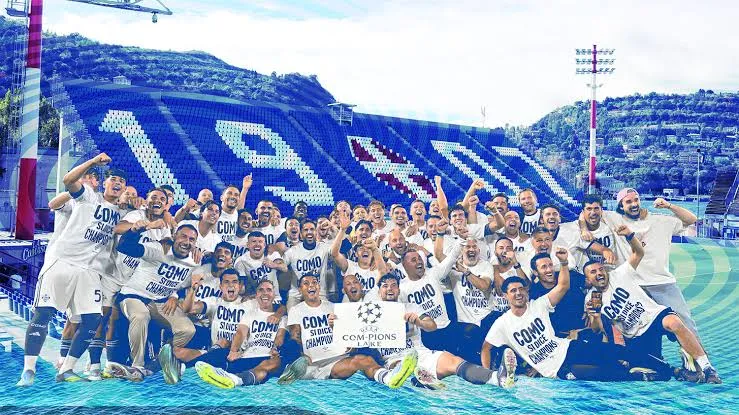
Como 1907 (Como) made history after crushing powerhouse Manchester United 4-1 in a Champions League group stage match. This fantastic victory marks an extraordinary milestone for the club owned by the Hartono family, which had once been relegated to Serie D before making a comeback.
Como’s journey to becoming the powerhouse it is today has been anything but smooth. The club, nicknamed I Lariani, once teetered on the brink of bankruptcy. In 2019, the Djarum Group, through SENT Entertainment, acquired Como with relatively limited funds.
In an interview a few years ago, Mirwan Suwarso—who currently serves as Como’s president—said that the Djarum Group originally purchased Como for less than 5 billion rupiah. With that amount, the Djarum Group managed to lift Como out of its slump. As a result, the team was ultimately promoted to Serie C in 2019.
In the 2021–2022 season, Como was promoted to Serie B. Como remained in Serie B for three seasons. It wasn’t until the 2024–2025 season that they were finally promoted to Serie A.
This means that the 2026–2027 season marks Como’s third season in Serie A. Even so, they have been able to compete at the top of Italian soccer’s top division, as evidenced by the fact that in their first season in Serie A, they finished in the top 10.
Unlike wealthy European clubs, Como does not engage in massive player acquisitions. As Como’s owner, Djarum has opted for a gradual approach. The club is being built from the ground up. Its structure and quality are being improved step by step.
At the start of the 2025–2026 season, Como signed eleven new players. However, five of them were loan signings who were eventually made permanent.
Como’s largest expenditure during the 2025 summer transfer window was 22.5 million euros to sign young Real Betis player Jesus Rodriguez.
Meanwhile, Como also added two new players during the January 2026 transfer window, with the highest fee amounting to just 12 million euros. Of course, this strategy kept the club’s growth under control.
The arrival of Cesc Fabregas as Como’s head coach has been a key factor. Interestingly, the former national team player—who helped lead Spain to the 2010 World Cup title—not only serves as head coach but is also a minority shareholder in the club alongside Arsenal legend Thierry Henry.
There’s no denying that Fabregas’s reputation as a coach hasn’t truly been put to the test yet. Even so, thanks to his steady hand, he’s been able to have a positive impact on Como’s development. Moreover, he’s also brought a fresh perspective to the team’s tactical approach and player development.
Undoubtedly, thanks to the collaboration of all parties and the gradual development of the club’s structure, Como has grown rapidly.
Como’s success in becoming one of the rising forces in Italian and European soccer is proof that the Djarum Group’s commitment to building the club—based at the Giuseppe Sinigaglia Stadium—is no half-measure.
Rather, they have built Como as a long-term project, not a short-term one, and this has been proven seven years after they acquired the club.
The story of Como 1907’s resurgence offers an important lesson for business and human resources management: organizations do not always excel because of large capital, but because they are able to build systems that allow every resource to be utilized to its fullest potential. Money remains important, but the ability to transform money into talent, talent into performance, and performance into sustainable excellence is even more decisive. Unfortunately, many organizations are preoccupied with simply recruiting the best people but neglect to create an environment that enables them to perform at their best.
The club, acquired in 2019 in a fragile state, has made a gradual climb from the lower divisions to Serie A. In terms of human resources, this aligns with organizational capability building: systematically building organizational capabilities before demanding complex results. Companies experiencing a decline in performance often rush to replace personnel, hire high-priced executives, or set aggressive targets—even though the problems may stem from unclear structures, overlapping authority, slow decision-making, and misaligned incentives. Competent individuals find it difficult to excel in an unsupportive system.
Talent management is more than just recruitment. Recruitment addresses who comes in; talent management addresses who is needed, what capabilities are being built, how individuals are developed and placed, and how their contributions are retained. Como’s approach shapes the team’s composition according to needs: recruitment, converted loan players, and investment in young players. Its HR agenda encompasses talent acquisition, development, retention, and optimization. A company doesn’t always have to hire the most expensive candidates; what matters are relevant competencies, learning potential, and strategic fit. The quality of HR decisions is measured not by the number of top-tier talents recruited, but by the ability to build a competency portfolio that achieves the company’s goals.
Cesc Fàbregas’s role serves as a reminder that reputation is not the same as the ability to build a team. Former star players possess knowledge and credibility, but they are not necessarily capable of setting direction, managing conflict, developing subordinates, and building trust. Leaders are judged by their ability to transform individual expertise into collective capacity and to ensure the organization continues to perform effectively even in their absence. Investing in young talent requires identifying potential, providing development opportunities, assigning roles based on strengths, and conducting evidence-based evaluations. A high-performance culture is built through clear roles, aligned goals, communication, fair evaluations, accountability, opportunities for learning, and a safe environment for expressing opinions.
A phased strategy requires strategic efficiency, not just cost-cutting. The question isn’t how much the HR budget should be cut, but rather which investments will have the greatest impact. Key performance indicators should include the quality of recruitment, development, succession planning, retention of key talent, productivity, and leadership quality. Once success is achieved, the challenge shifts to scaling up: expanding capacity without compromising success factors, through line leadership, competency systems, succession planning, and consistent evaluation.
Once again, the Como story should not be turned into a myth that money doesn’t matter. Capital, infrastructure, networks, and luck still play a role. The key lesson is the mindset: capital requires strategy, strategy requires an organization to execute it, and the organization depends on developed people. Outstanding organizations aren’t just because they have great people, but also because they’re able to help people grow, work together, and generate a collective impact that couldn’t be achieved alone.
#Como #Talent Management #Djarum #Mirwan Suwarso #Serie A #Cesc Fabregas #Organizational Capability Building #Collective Capacity