Whenever the continuity of a family business comes up, attention usually narrows to a single question: who replaces whom? Will the child take over the parent’s business? Who becomes CEO? Who sits on the board of commissioners? Which child is the most deserving successor? Is that successor ready to take the baton?
These are legitimate questions. But there is another one that rarely gets asked: who will manage the family’s wealth once the family business has grown far larger and far more complex than a single company?
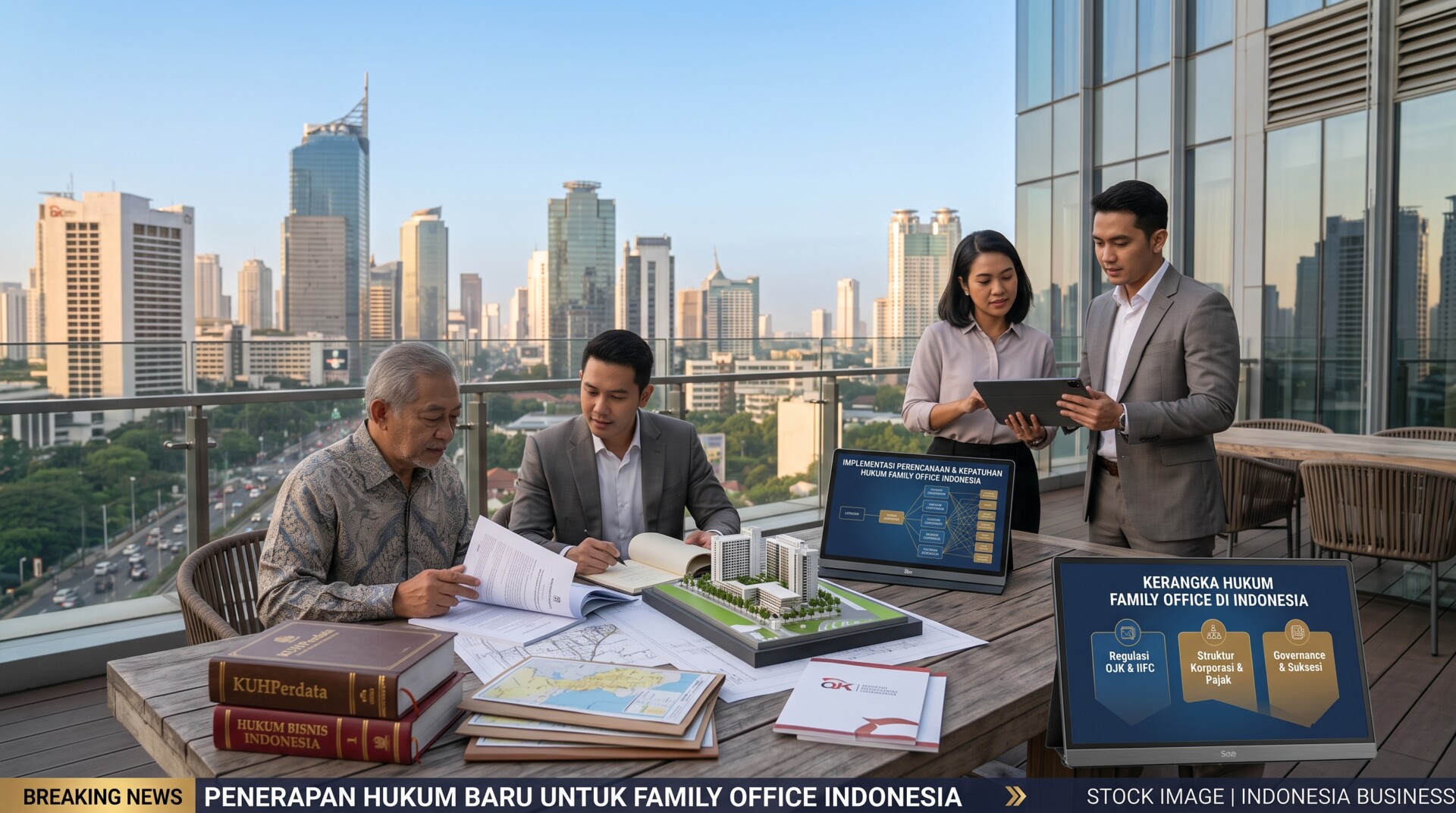
This is where the family office becomes significant, and Indonesia appears to be heading in that direction. As quoted by investortrust.id, Mukhamad Misbakhun, Chairman of Commission XI of the House of Representatives, has said that family offices will be brought into the Indonesia International Financial Center (IIFC) ecosystem. Regulations governing family offices will be issued separately, with tax incentives, dedicated supervision, and dispute resolution mechanisms all under consideration. Notably, this development coincides with a broader shift in Indonesia’s financial sector regulatory landscape.
For family businesses, however, the family office should not be viewed merely as a facility for attracting wealthy money from abroad. Its role is far more strategic than that: it is an instrument for preserving governance, wealth, and family continuity across generations.
A family business usually starts simply. The founder builds and grows the business. The children join. The company then expands into several sectors.
The complications begin once wealth is no longer concentrated in a single company. A family may hold shares, a holding company, property, time deposits, bonds, offshore assets, and more. At this stage, a new set of problems emerges. The family business needs governance, for both the business and the family. A family office can serve as the hub that helps the family manage investments, risk, taxation, estate planning, philanthropy, and even the transfer of wealth between generations.
Law No. 4 of 2026 amending Law No. 4 of 2023 on the Development and Strengthening of the Financial Sector (the P2SK Law) does not mention family offices specifically. It does, however, contain a number of provisions relevant to family businesses: rules on the Ultimate Controlling Shareholder (Pemegang Saham Pengendali Terakhir, or PSPT); on financial conglomerates, defined by ownership and control linkages; and on the Financial Holding Company (Perusahaan Induk Konglomerasi Keuangan, or PIKK), the legal entity owned by a controlling or ultimate controlling shareholder to control and consolidate the activities of a financial conglomerate. None of these relate directly to family offices. Given how significant family businesses are to the Indonesian economy, though, they are well worth watching closely. Indonesian regulation is paying ever closer attention to who the real owners are, who exercises control, and how interconnected entities are managed.
For business families, this matters enormously. The wealthier a family becomes, the harder it is to draw a line between business wealth and family wealth, especially when governance is still loose.
A family office can act as a conductor, making sure that decisions on investment, risk, liquidity, succession, and family interests do not run in separate directions. Founders are usually skilled at accumulating wealth. Successors need a different skill set altogether: how to preserve and grow that wealth while keeping the family together.
Not Wealth, but Governance
This is why the family office holds such promise for Indonesian family businesses. Imagine a family with assets worth ten trillion rupiah. The first generation is still alive and making the decisions. Then the founder passes away, and the assets are divided among four children. Ten years later, each of those four children has three or four children of their own. Suddenly a single family has a great many members, each with their own interests, risk profile, financial needs, business vision, and lifestyle. The assets are still there, but the alignment is gone. This is precisely where a family office can function as the shared repository of the family’s knowledge, experience, facts, policies, and values.
A Shift in Perspective
Which child will lead the family business next? That question has always sat at the center of the succession conversation. With a family office in place, the question changes: as the number of owners grows and disperses, and as each generation moves further from the founder, say the third generation and beyond, how should family wealth be managed?
That is a significant shift in perspective. Not every family member can be CEO, and it would be impossible for them to be. Not every family member has to work in the company. Not every child has to be an entrepreneur. Every family member does, however, need to understand their own rights and obligations, the family’s investment principles, risk and liquidity management, inheritance, and the relationship between family wealth and business operations.
A healthy family office produces productive capital, not merely parked capital. A family’s wealth should not simply sit still. It should be directed in stages, from capital preservation to business growth, strategic investment, innovation, philanthropy, and the development of the next generation’s capacity.
Family businesses often collapse not because the company posted heavy losses, but because the family could no longer manage its own ownership. The founder dies, conflict erupts between siblings, shareholdings fracture, assets are sold off for personal gain, or the next generation simply has no understanding of the business. A company built over decades of hard work can disappear within a single generation. A family office does not automatically prevent that scenario. What it does provide is an institution capable of managing an increasingly complex family.
Ideally, a family office does far more than manage wealth. Its remit should encompass investment and risk governance, ownership and succession governance, the management of conflicting family interests, philanthropic activity, and the preparation of the younger generation to grow into responsible owners.
It is worth remembering, though, that a family office is not a substitute for family governance. The family still needs a family constitution, a family council, clear ownership rules, conflict resolution mechanisms, and firm succession principles. A family office is infrastructure, and infrastructure cannot define a family’s vision, build trust, resolve conflict, or give meaning to a legacy.
#familyoffice #familybusiness #familygovernance #succession #IIFC #riskmanagement #productivecapital